Search
Poll
Text Size
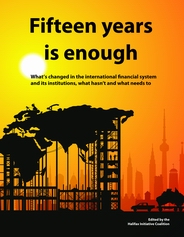
What’s changed in the international financial system and its institutions, what hasn’t and what needs to
Executive Summary
Back in 1995, the G7 met in Halifax during a “time of change and opportunity.” The meeting took place in a context of mounting deficits and debt crises in countries in the South; in the wake of economic collapse in Mexico; and amid strong global criticism from civil society, the media and governments about the World Bank and International Monetary Fund’s (IMF) austere neo-liberal structural adjustment policies.
A lot has changed since then, partly in response to the Halifax G7 Summit and subsequent G7 and G8 meetings. Too many of these improvements, however, exist only on paper. Beyond the surface, the neo-liberal, market-oriented bias that guides the Bank and Fund’s agenda and thinking has not altered.
The 2010 G8 Summit in Toronto in 2010 takes place during another “time of change and opportunity.” The financial crisis has spurred many civil society organizations (CSOs) to insist on far-reaching changes to the global financial system and its institutions. Clearly, as this publication will illustrate, 15 years of refusing to deal with the manifest shortcomings of the global economic system is enough.
What’s changed in the international financial system and its institutions, what hasn’t and what needs to
Executive Summary
Back in 1995, the G7 met in Halifax during a “time of change and opportunity.” The meeting took place in a context of mounting deficits and debt crises in countries in the South; in the wake of economic collapse in Mexico; and amid strong global criticism from civil society, the media and governments about the World Bank and International Monetary Fund’s (IMF) austere neo-liberal structural adjustment policies.
A lot has changed since then, partly in response to the Halifax G7 Summit and subsequent G7 and G8 meetings. Too many of these improvements, however, exist only on paper. Beyond the surface, the neo-liberal, market-oriented bias that guides the Bank and Fund’s agenda and thinking has not altered.
The 2010 G8 Summit in Toronto in 2010 takes place during another “time of change and opportunity.” The financial crisis has spurred many civil society organizations (CSOs) to insist on far-reaching changes to the global financial system and its institutions. Clearly, as this publication will illustrate, 15 years of refusing to deal with the manifest shortcomings of the global economic system is enough.
What’s changed in the international financial system and its institutions, what hasn’t and what needs to
Executive Summary
Back in 1995, the G7 met in Halifax during a “time of change and opportunity.” The meeting took place in a context of mounting deficits and debt crises in countries in the South; in the wake of economic collapse in Mexico; and amid strong global criticism from civil society, the media and governments about the World Bank and International Monetary Fund’s (IMF) austere neo-liberal structural adjustment policies.
A lot has changed since then, partly in response to the Halifax G7 Summit and subsequent G7 and G8 meetings. Too many of these improvements, however, exist only on paper. Beyond the surface, the neo-liberal, market-oriented bias that guides the Bank and Fund’s agenda and thinking has not altered.
The 2010 G8 Summit in Toronto in 2010 takes place during another “time of change and opportunity.” The financial crisis has spurred many civil society organizations (CSOs) to insist on far-reaching changes to the global financial system and its institutions. Clearly, as this publication will illustrate, 15 years of refusing to deal with the manifest shortcomings of the global economic system is enough.
Rethinking the international financial system during a time of crisis
Introduction
On October 19 and 20, 2009, the Halifax Initiative held a conference, co-hosted by The North South Institute, the University of Ottawa and the School of International Development and Global Studies (SIDGS), entitled "What’s Missing in the Response to the Global Financial Crisis?" The meeting brought together experts from a range of backgrounds to analyze the challenges facing the global economy, discuss the ways in which the international community has responded to the current financial crisis, and identify shortcomings in these responses.
Rethinking the international financial system during a time of crisis
Introduction
On October 19 and 20, 2009, the Halifax Initiative held a conference, co-hosted by The North South Institute, the University of Ottawa and the School of International Development and Global Studies (SIDGS), entitled "What’s Missing in the Response to the Global Financial Crisis?" The meeting brought together experts from a range of backgrounds to analyze the challenges facing the global economy, discuss the ways in which the international community has responded to the current financial crisis, and identify shortcomings in these responses.
![]() |
A new CNCA web site and publication that documents, with case studies, the eight ways the Federal Government supports Canadian mining, oil and gas companies abroad. The Halifax Initiative was a contributing author to the publication.
|
![]() |
A new CNCA web site and publication that documents, with case studies, the eight ways the Federal Government supports Canadian mining, oil and gas companies abroad. The Halifax Initiative was a contributing author to the publication.
|
PDF of Full Report available here
Nous regrettons qu'en 2006, l'initiative d'Halifax n'a pas produit de version Francaise.
Report Card on the Canadian Department of Finance “2005 Report on Operations Under Bretton Woods and Related Agreements Act”
Introduction
Every year at the end of March,[1] the Department of Finance tables its report on the operations of the Bretton Woods Institutions (BWI) [2] before Parliament and details activities at these institutions in relation to Canadian priorities, commitments and interests. The reports provide some good background information on the institutions themselves, on emerging issues and challenges within the World Bank and International Monetary Fund (IMF), and some brief details on Canadian priorities and financial participation at these institutions.
PDF of Full Report available here
Nous regrettons qu'en 2006, l'initiative d'Halifax n'a pas produit de version Francaise.
Report Card on the Canadian Department of Finance “2005 Report on Operations Under Bretton Woods and Related Agreements Act”
Introduction
Every year at the end of March,[1] the Department of Finance tables its report on the operations of the Bretton Woods Institutions (BWI) [2] before Parliament and details activities at these institutions in relation to Canadian priorities, commitments and interests. The reports provide some good background information on the institutions themselves, on emerging issues and challenges within the World Bank and International Monetary Fund (IMF), and some brief details on Canadian priorities and financial participation at these institutions.
PDF of Full Report available here
Nous regrettons qu'en 2006, l'initiative d'Halifax n'a pas produit de version Francaise.
Report Card on the Canadian Department of Finance “2005 Report on Operations Under Bretton Woods and Related Agreements Act”
Introduction
Every year at the end of March,[1] the Department of Finance tables its report on the operations of the Bretton Woods Institutions (BWI) [2] before Parliament and details activities at these institutions in relation to Canadian priorities, commitments and interests. The reports provide some good background information on the institutions themselves, on emerging issues and challenges within the World Bank and International Monetary Fund (IMF), and some brief details on Canadian priorities and financial participation at these institutions.
PDF of Full Report available here
Nous regrettons qu'en 2006, l'initiative d'Halifax n'a pas produit de version Francaise.
Report Card on the Canadian Department of Finance “2005 Report on Operations Under Bretton Woods and Related Agreements Act”
Introduction
Every year at the end of March,[1] the Department of Finance tables its report on the operations of the Bretton Woods Institutions (BWI) [2] before Parliament and details activities at these institutions in relation to Canadian priorities, commitments and interests. The reports provide some good background information on the institutions themselves, on emerging issues and challenges within the World Bank and International Monetary Fund (IMF), and some brief details on Canadian priorities and financial participation at these institutions.
PDF of Full Report available here
Nous regrettons qu'en 2006, l'initiative d'Halifax n'a pas produit de version Francaise.
Report Card on the Canadian Department of Finance “2005 Report on Operations Under Bretton Woods and Related Agreements Act”
Introduction
Every year at the end of March,[1] the Department of Finance tables its report on the operations of the Bretton Woods Institutions (BWI) [2] before Parliament and details activities at these institutions in relation to Canadian priorities, commitments and interests. The reports provide some good background information on the institutions themselves, on emerging issues and challenges within the World Bank and International Monetary Fund (IMF), and some brief details on Canadian priorities and financial participation at these institutions.
PDF of Full Report available here
Nous regrettons qu'en 2006, l'initiative d'Halifax n'a pas produit de version Francaise.
Report Card on the Canadian Department of Finance “2005 Report on Operations Under Bretton Woods and Related Agreements Act”
Introduction
Every year at the end of March,[1] the Department of Finance tables its report on the operations of the Bretton Woods Institutions (BWI) [2] before Parliament and details activities at these institutions in relation to Canadian priorities, commitments and interests. The reports provide some good background information on the institutions themselves, on emerging issues and challenges within the World Bank and International Monetary Fund (IMF), and some brief details on Canadian priorities and financial participation at these institutions.
Full Report PDF
Summary Analysis of the June 11, 2005 G8 Debt Proposal
On June 11, Finance Ministers from the G8 countries announced a debt remission proposal that would cancel multilateral debts owed to the World Bank, the International Monetary Fund (IMF) and the African Development Bank's African Development Fund (AfDF) by 18 low-income countries.
The G8 proposal offers 100% debt stock cancellation for debts owed to three multilateral financial institutions for the 18 countries that have reached their 'completion points' through the Heavily Indebted Poor Country (HIPC) Initiative. A further 9 HIPC 'decision point' countries, who have not completed or have stalled in their World Bank/IMF programs, might qualify in the near term. The deal could also potentially be extended to the 11 remaining HIPCs that have not yet reached their decision points.
Revised - June 18 2003
Structural Adjustment in Canada
Most Canadians would be surprised to learn that economists from the International Monetary Fund (IMF) annually visit Canada to dispense advice. We tend to think of the IMF as an institution that prescribes strong medicine, known as Structural Adjustment Programs (SAPs), only to less developed countries. In fact our governments regularly follow the same bitter prescriptions.
In 1990 Prime Minister Brian Mulroney boldly declared that Canada needed to undergo structural adjustment which he promised to deliver through free trade agreements with the US and Mexico and harsh spending cuts. Little changed when the Liberals came to power. Much of the content of Finance Minister Paul Martin’s crucial 1995 budget that slashed our social safety net followed directives that came straight from the IMF.
Revised - June 18 2003
Structural Adjustment in Canada
Most Canadians would be surprised to learn that economists from the International Monetary Fund (IMF) annually visit Canada to dispense advice. We tend to think of the IMF as an institution that prescribes strong medicine, known as Structural Adjustment Programs (SAPs), only to less developed countries. In fact our governments regularly follow the same bitter prescriptions.
In 1990 Prime Minister Brian Mulroney boldly declared that Canada needed to undergo structural adjustment which he promised to deliver through free trade agreements with the US and Mexico and harsh spending cuts. Little changed when the Liberals came to power. Much of the content of Finance Minister Paul Martin’s crucial 1995 budget that slashed our social safety net followed directives that came straight from the IMF.
Revised - June 18 2003
Structural Adjustment in Canada
Most Canadians would be surprised to learn that economists from the International Monetary Fund (IMF) annually visit Canada to dispense advice. We tend to think of the IMF as an institution that prescribes strong medicine, known as Structural Adjustment Programs (SAPs), only to less developed countries. In fact our governments regularly follow the same bitter prescriptions.
In 1990 Prime Minister Brian Mulroney boldly declared that Canada needed to undergo structural adjustment which he promised to deliver through free trade agreements with the US and Mexico and harsh spending cuts. Little changed when the Liberals came to power. Much of the content of Finance Minister Paul Martin’s crucial 1995 budget that slashed our social safety net followed directives that came straight from the IMF.
In Canada, CASA is being undertaken by a Steering Committee of non-governmental organizations from a number of sectors, including labour, development and anti-poverty organizations. As Canada does not receive structural adjustment loans from international financial institutions, the Steering Committee in Canada chose to focus on the 1995 budget, in which the federal government pushed through many structural adjustment reforms, reforms recommended to Canada by the IMF in its Article IV consultations. A first national forum was held, December, 1998 from which four research areas were chosen:
Introduction
The International Monetary Fund and the World Bank have proposed a framework of action to assist in resolving the debt problems of heavily indebted poor countries. In the current formulation of this framework, replenishment of the Enhanced Structural Adjustment Facility (ESAF) has been presented as the centrepiece of the IMF contribution.
The IMF role was described in the brief prepared by IMF and World Bank staff for the April 23, 1996 meeting of the Development Committee:
"The IMF would also be expected to take action that would reduce the present value of its claims on a country, consistent with broad and equitable participation in the framework of this initiative. Various possibilities involving support under the ESAF which might achieve this objective are currently under examination."
Introduction
The International Monetary Fund and the World Bank have proposed a framework of action to assist in resolving the debt problems of heavily indebted poor countries. In the current formulation of this framework, replenishment of the Enhanced Structural Adjustment Facility (ESAF) has been presented as the centrepiece of the IMF contribution.
The IMF role was described in the brief prepared by IMF and World Bank staff for the April 23, 1996 meeting of the Development Committee:
"The IMF would also be expected to take action that would reduce the present value of its claims on a country, consistent with broad and equitable participation in the framework of this initiative. Various possibilities involving support under the ESAF which might achieve this objective are currently under examination."
This information was provided to the Halifax Initiative Coalition (the Social Justice Committee is a member) Sept. 30 1999, in response to a request under the Access to Information Act.
SECRET
INTERNATIONAL MONETARY FUND
CANADA
Article IV Consultation Discussions
Statement by the Fund Mission to the Minister of Finance
Ottawa, December 7, 1995